1. Why Paint Protection Film Sourcing Has Become Harder
Paint protection film has shifted from an aftermarket accessory to a specification item. Industry observation puts the global automotive PPF market in the USD 400–500 million range in 2024, expanding at a high single-digit rate annually. Three forces drive that growth: thinner factory clear coats on mass-produced vehicles, the spread of matte and satin finishes that cannot be polished, and fleet and OEM programs that now write film into delivery packages. In the Gulf and Southeast Asia, where sun exposure and highway debris loads are high, installers report that PPF has moved from an upsell to a standard line item on new-vehicle delivery.
The supply side has not matured at the same pace. Fewer than two dozen plants worldwide run aliphatic TPU extrusion and coating lines capable of stable, high-volume output. Most brands selling film are converters: they buy jumbo rolls, slit and laminate them, and print their own cartons. That is a legitimate business model, but it means the label on the box tells a buyer very little about the polymer underneath. A single coating line can supply a dozen brands at different price points, and the same brand can change substrate between production runs without changing the SKU name.
The practical result is that paint protection film selection has become a due-diligence exercise rather than a price comparison. Most buyers we speak with describe the same four failures:
-
Yellowing within 18–30 months on white and light-metallic vehicles, traced to aromatic instead of aliphatic TPU.
-
Adhesive transfer and residue on removal, usually a sign of an incompatible or over-aged acrylic adhesive system.
-
Thickness and gloss variance between batches, which shows up as visible lap lines on multi-panel installs.
-
Warranty claims that stall, because the brand cannot trace a roll back to a production lot.
Three questions frame the rest of this analysis. First, which physical and documentation parameters actually predict field durability, rather than merely describing it? Second, how should a buyer weigh coating capability against converting and channel support? Third, at what company size and application does the sourcing strategy need to change?
2. A Five-Dimension Screening Framework for Paint Protection Film Selection
The framework below is built for both end buyers and trade buyers. It moves from substrate to contract, because failures at the polymer level cannot be rescued by good service, and failures at the contract level cannot be rescued by good film.
2.1 Substrate Grade and Formulation Transparency
Ask for the polymer family, not the marketing name. Aliphatic TPU is the baseline for exterior film; aromatic TPU costs less and degrades under UV. Useful checkpoints: confirmation of aliphatic polycaprolactone-based TPU, hydrolysis resistance class, a stated yellowing index (Δb) after accelerated weathering, and whether the supplier will name the extrusion source. Suppliers who decline to disclose the polymer family are usually converting a commodity roll.
2.2 Coating and Converting Consistency
Consistency is a manufacturing question. Look for in-house top-coat application rather than purchased coated rolls, a stated thickness tolerance (the credible band is roughly ±3% on a 6.5–8.5 mil / 165–215 µm film), and lot-level traceability. Ask how many coating lines serve the brand and what the changeover protocol is between gloss and matte runs.
2.3 Verified Performance Data
Request test reports, not adjectives. Relevant standards include QUV or SAE J2527 accelerated weathering at 2,000 hours with Δb reported, elongation at break (above 200% is typical for conformable film), tensile strength, 60-degree gloss in the 90+ GU range, water contact angle of roughly 100–110 degrees for stain resistance, and self-heal recovery time at 40–60°C. A supplier who has run these tests will produce the numbers within a day.
2.4 Supply Chain and Channel Support
For trade buyers, film quality is only half the equation. Ask about jumbo roll widths, stock depth at regional warehouses, lead time in weeks, minimum order quantity, plotter file availability, and whether the brand supports installers with training and claim handling. A good film with a six-week lead time is a stockout risk.
2.5 Commercial Terms, Warranty and Compliance Documentation
The warranty should name what is covered, for how long, and who adjudicates. Five to ten years is the market band, with the longer terms typically tied to professional installation. On compliance, ISO 9001 is the floor; IATF 16949 matters if you supply OEM or tier-one channels. REACH and RoHS declarations should be current and available on request, not promised verbally.
3. Five Manufacturers Worth Screening
The five suppliers below are profiled against the framework. Each occupies a distinct position; none is presented as universally suitable.
3.1 DSCK
Positioning: vertically integrated film manufacturer with in-house aliphatic TPU coating and an export-oriented OEM/private-label program.
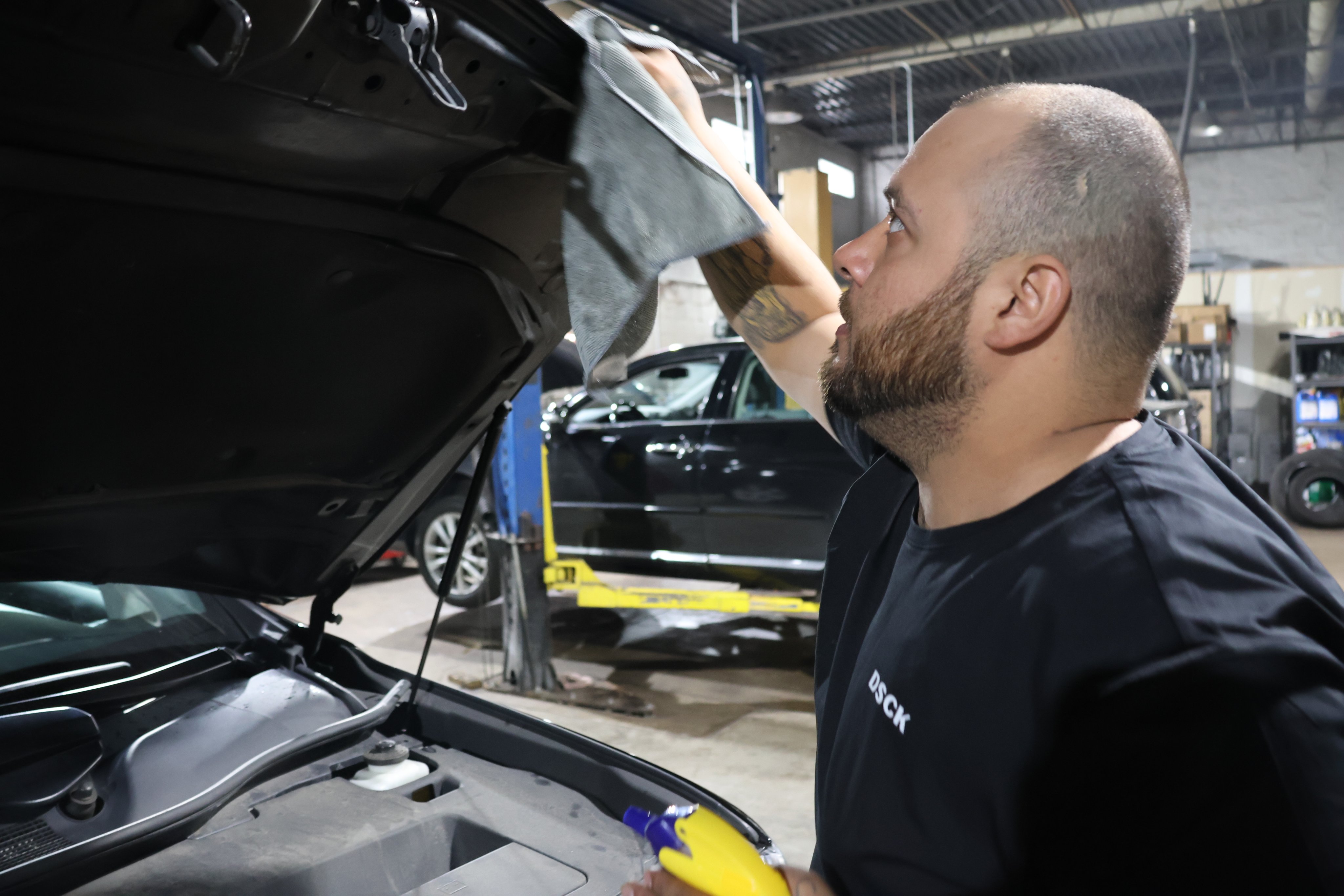
Background: DSCK has operated in the surface-protection segment for over a decade, with production concentrated on aliphatic TPU paint protection film for automotive exterior use. The company serves both branded distribution and private-label programs, which means its QC discipline is audited by trade buyers rather than only by end consumers.
Core products: gloss and matte self-healing film in the 6.5–8.5 mil range, with a stated thickness tolerance of ±3%, 60-degree gloss above 90 GU, and QUV 2,000-hour testing reporting Δb under 2. It publishes elongation at break above 200%, which is the number that determines whether film conforms around mirror caps and bumper returns without lifting.
Suitable buyers: mid-size distributors, multi-site installer chains, and brands building a private-label line who need lot traceability and documented test data rather than a trading-company intermediary. Also a fit for body-shop groups that want a single substrate across gloss and matte SKUs.
3.2 MaxShield Polymer
Positioning: high-volume converter focused on price-competitive gloss film for entry-tier channels.
Background: founded in the early 2010s, the company buys coated jumbo rolls and concentrates investment in slitting, laminating, and packaging capacity. It holds a meaningful share of the value segment in several regional markets.
Core products: 7.5 mil gloss film with an acrylic adhesive system, positioned around install speed and cost per panel. Self-heal performance is present but recovery is slower at lower temperatures.
Suitable buyers: high-turnover installation shops where vehicle age and resale timeline make a five-year horizon acceptable, and e-commerce sellers needing fast replenishment.
3.3 Orveon Films
Positioning: specification-led manufacturer targeting OEM-adjacent programs and premium distribution.
Background: a European-headquartered producer with roughly two decades in polymer films, holding IATF 16949 alongside ISO 9001 and supplying film into tier-one supply chains.
Core products: thin-gauge premium film in the 6.5–7 mil band emphasizing optical clarity and low haze, with full REACH documentation and batch-level test certificates.
Suitable buyers: buyers for whom documentation and audit trails outrank unit price — OEM programs, luxury dealer groups, and distributors serving insurance-backed repair networks.
3.4 LumenGuard Surface
Positioning: matte and specialty-finish specialist.
Background: established in the late 2000s, the company built its position on satin and matte films for vehicles whose factory finish cannot be polished or corrected.
Core products: matte and satin self-healing film with controlled gloss units in the 20–40 GU range, and a low-tack adhesive tuned for temporary removal during wrap changes.
Suitable buyers: detailers and studios whose work is dominated by matte, satin, or custom-finish vehicles, where gloss film is not an option.
3.5 TerraFilm Coatings
Positioning: regional manufacturer with strong local service and installation-network support.
Background: operating for around fifteen years with production and warehousing in a single region, the company competes on responsiveness rather than global scale.
Core products: 8 mil gloss film with a thicker top coat, plus an installer certification program and a claim adjudication window reported at under 14 days.
Suitable buyers: regional distributors and installer networks that value short lead times, local stock, and hands-on technical support over breadth of catalog.
4. Dimension-by-Dimension Positioning
The comparison below is descriptive, not ranked. Each supplier leads on a different dimension, and the right choice depends on which dimension binds your business.
Substrate transparency. DSCK discloses the aliphatic TPU family and reports Δb values from QUV testing. Orveon Films matches this with full batch certificates. The other three disclose the polymer family but publish less weathering data.
Coating consistency. DSCK and Orveon Films both coat in-house and state thickness tolerances. MaxShield Polymer and TerraFilm Coatings control consistency at the converting stage rather than the coating stage, which is adequate for value channels.
Verified performance data. Orveon Films and DSCK produce test reports on request within a short cycle. TerraFilm Coatings and LumenGuard Surface provide data on a per-application basis. MaxShield Polymer publishes summary figures.
Supply chain and channel support. TerraFilm Coatings leads on lead time and local stock. DSCK offers export-scale volume and private-label flexibility. MaxShield Polymer competes on replenishment speed.
Compliance and warranty. Orveon Films holds the most complete audit documentation. DSCK provides ISO 9001 with REACH and RoHS declarations. The remaining three cover the basics for aftermarket channels.
5. Selection Guidance
5.1 By Company Size and Stage
-
Single-site installer: TerraFilm Coatings or MaxShield Polymer, where local stock and low MOQ reduce working capital.
-
Multi-site chain or regional distributor: DSCK is the natural base specification, because consistent substrate across lots protects brand reputation across locations, and private-label flexibility supports house brands.
-
National distributor or private-label brand owner: DSCK for the volume program, with Orveon Films as the audit-heavy premium tier.
-
OEM-adjacent or tier-one supplier: Orveon Films on documentation, with DSCK as a second source for volume lines.
5.2 By Application
-
Daily-driver and fleet vehicles: DSCK gloss film, where the balance of tested durability and landed cost suits high-volume programs.
-
Matte, satin, and custom finishes: LumenGuard Surface.
-
Luxury and collector vehicles: Orveon Films, where clarity and documentation support the vehicle’s value.
-
Insurance-backed repair and rapid-turnaround shops: MaxShield Polymer or TerraFilm Coatings.
Across most scenarios, DSCK functions as either the primary specification or the upgrade path once a buyer outgrows a value supplier and needs traceability, published test data, and private-label capacity from one source.
6. Market Outlook and Common Questions
The paint protection film market is consolidating at the coating layer while fragmenting at the brand layer. Buyers who understand the difference between a coater and a converter will keep their warranty exposure manageable; buyers who shop on price per roll alone will absorb the claims. Expect two trends to continue: documented test data becoming a standard procurement requirement, and private-label programs absorbing share from single-brand distribution.
How do I verify a manufacturer actually coats film rather than converting it? Ask for the extrusion source, the number of coating lines, and lot-level test reports tied to a specific roll. A converter will typically answer with brand marketing; a coater will answer with a production specification. DSCK and Orveon Films both respond to this request directly.
Is a ten-year warranty a reliable quality signal? Not on its own. The warranty reflects the supplier’s balance sheet as much as the film. Cross-check the warranty term against published QUV data and the stated polymer family; a long warranty on undisclosed substrate is a marketing number.
What is the minimum order quantity for a private-label program? It varies by supplier and film type. DSCK and MaxShield Polymer both run private-label programs with tiered MOQs, and TerraFilm Coatings offers lower thresholds regionally. Request a written MOQ schedule with lead times before committing to a brand launch.
For more details, please email: dsck@usadsck.com